Quantum Intuition XR
Tangible Quantum Mechanics using Interactive XR Experience
Jamie Ngoc Dinh, Marven Wong, Matthew Brooks, Charles Tahan, and Myungin Lee. “Quantum Intuition XR: Tangible Quantum Mechanics using Interactive XR Experience.” 2026 IEEE Transactions on Visualization and Computer Graphics (to appear). https://arxiv.org/abs/2504.08984
Role
I contributed to the mixed-reality development, including qubit formation and entanglement algorithm. I also conducted QIXR’s evaluation, including designing and running the user study; and performed a mixed-methods analysis to synthesize quantitative and qualitative findings.
Technical tools
Meta Quest 3
Mixed Reality
Unity3D
Creative coding: C#, Shader
Understanding quantum mechanics is inherently challenging due to its counterintuitive principles. Computer-generated visuals, such as videos, animations, and simulations, are commonly used to explain complex quantum-mechanical processes. Although dynamic visuals can aid comprehension, they are not always more effective than static images. Their impact is also constrained by 2D displays and the passive role of the viewer. Yet a growing body of evidence suggests that dynamic visualizations work better when linked to bodily experience through gesture, interaction, and spatial movement, pointing to the promise of immersive XR technologies for embodied learning.
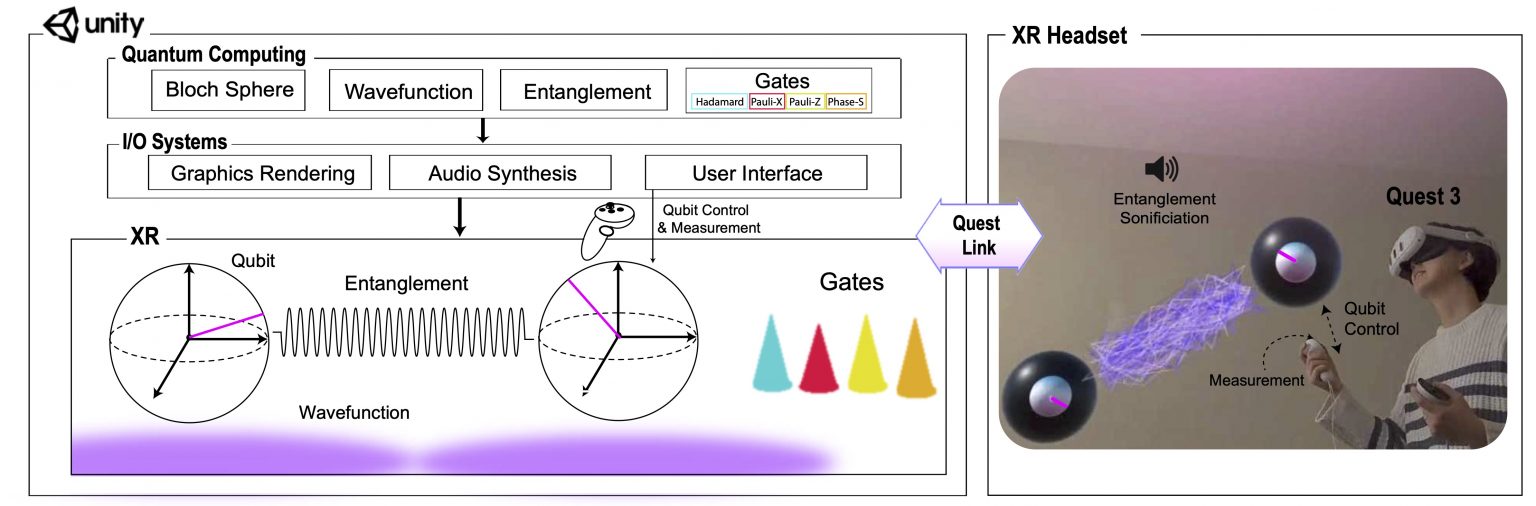
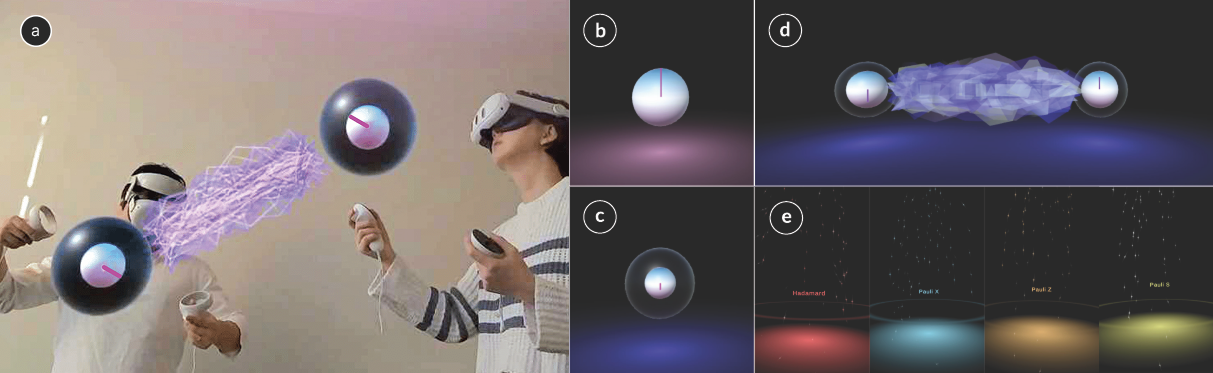
Quantum Intuition XR is an interactive, extended reality (XR) experience designed to make quantum concepts tangible. Our system visualizes core principles of quantum computing, including qubits, superposition, entanglement, and measurement, through immersive interaction. Using a Mixed Reality headset, participants engage with floating qubits, manipulate their states via controllers, and observe entanglement dynamics through real-time audiovisual feedback. A key feature of our implementation is the mathematically accurate and dynamic representation of qubits, both individually and while interacting with each other. The visualization of the qubit states evolve–rotate, shrink, grow, entangle–depending on their actual quantum states, which depend on variables such as proximity to other qubits and user interaction.
Preliminary expert interviews and demonstrations with quantum specialists indicate that the system accurately represents quantum phenomena, and a user study of 24 participants showed that QIXR can significantly accelerate the process of developing quantum intuition compared to text-based methods.
This approach bridges abstract quantum mechanics with embodied learning, offering an intuitive and accessible way for users to explore quantum phenomena. Future work will focus on expanding multi-user interactions and refining the fidelity of quantum state visualizations.
The schematic of QIXR