Jamie Dinh's Teaching Portfolio
Welcome and thank you for visiting my Teaching Portfolio. Here, you’ll find a mix of materials that capture who I am as an instructor and mentor.
Head over to my Teaching Philosophy section to get a feel for my teaching beliefs, then explore the Syllabi and Classroom Activities to see how I put those ideas into action.
The Students’ Work section highlights some projects I’ve mentored, and the Teaching Evaluations show what students have to say about me.
I feel most impactful when I’m teaching and mentoring. I owe who I am today to the incredible educators who guided me throughout my education, and I’m passionate about paying it forward to the next generation of learners.
Growing up in a family of university professors, I was surrounded by academia from an early age and naturally believed that teaching was my calling. My first foray into teaching came when I tutored chemistry in high school. I spent countless hours preparing content, aiming to be the “knowledge keeper” for a group of middle school students. However, I soon noticed that my lectures weren’t capturing their interest—some were on their phones, others chatting or even dozing off. That experience left me wondering what teaching was really about.
It wasn’t until my junior year of college that I realized what had gone wrong in my tutoring. Serving as Vice President of an international student-led NGO, I initially oversaw a team of 15 members who waited in silence for my instructions. Once I introduced monthly one-on-one mentoring sessions, however, they became proactive, asking how they could better achieve their goals. I realized that mentoring and tutoring go beyond mere “content expertise”; they hinge on the capacity to listen, empowering mentees to take ownership of their growth, and collaborating on goals. After then, each mentoring session would begin with me prompting them to reflect on their month—what they learned, their setbacks, and their challenges— and we charted a path forward together.
I believe teaching is empowering student to take ownership of their education, teaching them to ask questions and fostering self-directed learning. In my classes, I integrate active learning strategies such as open-ended discussions, project-based assignments, reflective journaling, and one-on-one office hours. I want every student to leave class with a clear sense of what the topic is about, whether they enjoy the topic and, if they do, feel fully equipped to pursue it further even when the class ends.
In my Augmented Reality (AR) Design course, for example, I encourage students to propose their own project ideas, frame their own research questions, and explore diverse methods to find answers. Given the emerging nature of AR and the abundance of available resources, we offer a wide array of tools and methodologies, and weigh each option’s strengths and limitations together in class. Outside of class, we provide comprehensive documents pointing to resources and tutorials. We also review an extensive list of keywords and concepts, ensuring they develop a broad awareness of current topics and can pinpoint the most fitting tool for each context. Meanwhile, in a shorter two-day VR workshop, I focus on equipping participants with foundational terminology, introducing core concepts, and directing them to relevant resources, trusting them to apply this knowledge according to their individual learning styles.
I believe that feedback and reflection are powerful tools for fostering self-directed learning. Personalized feedback—whether through one-on-one coaching during office hours or through peer reviews—gives students the best chance to understand their progress and grow. For example, while mentoring in the New Works Incubator program, my mentees not only built prototypes but also engaged in regular, iterative reflections on what worked, what didn’t, and what to tackle next. This process helped them refine both their designs and their overall learning strategies. In my classes, we dedicate time to checking in on each student’s progress, discussing challenges, and offering tailored feedback on both in-class and online assignments. Each week, students submit brief reflections that detail their progress, the problems they encountered, and the reasons behind the changes they made. I encourage them to come prepared with logs of their work when seeking help so that we can work through issues together. Ultimately, this approach builds their confidence and critical thinking skills, empowering them to take charge of their own educational journeys.
One of my most memorable class experiences was when we organized a cross-usability testing session. In this exercise, each group presented their project to another team, who acted as users testing out their prototypes. The group rotated until every project had been reviewed by all groups. By the end of the session, each team had received personalized insights from their peers, and we wrapped up by sharing strategies on how to analyze and apply the feedback effectively.
I believe learning is doing, and facilitating an engaged and dynamic classroom is key. For teaching emerging technologies, playtesting is a great way to introduce the tech and hook student’s interest into the topic. In many of my workshops and classes, I start by having students playtest interesting tools or prototypes I’ve collected, which naturally leads to open-ended discussions about their experiences. While teaching Computational Virtual Reality course, I dedicate class time to a studio format where we work through coding exercises together—or students work independently while I circulate to offer help. When class time is limited, I aim to prioritize interactive activities by having students watch recorded lectures beforehand and then following up with in-class quizzes/activities. In my AR Design class, half of every session is devoted to hands-on experiment studio work, giving students the opportunity to create something tangible each day and take that excitement home with them.
I believe teaching design is fundamentally about guiding students to think critically and generate impactful ideas, rather than merely mastering a set of tools. Yet, in real-world settings, design isn’t solely about creativity; it also involves understanding technical constraints and empathizing with users to effectively collaborate with stakeholders such as developers and product managers. To foster this mindset, I encourage students to explore and propose ideas they are genuinely passionate about before diving into technical details or feasibility studies. Once they have a concept in mind, they learn to navigate real-world limitations and adjust their designs accordingly. I also emphasize user testing, prompting students to observe how people interact with their prototypes, gather data on usability challenges, and refine their solutions based on feedback. Through these reflective iterations, they develop designs that are both innovative and practical.
I believe one valuable resource an instructor can offer is their professional network. By inviting guest speakers—industry professionals, alumni, and experts from diverse backgrounds—into my courses, I aim to broaden students’ perspectives far beyond the classroom. These interactions expose them to real-world challenges, potential career paths, and demonstrate why certain skills and knowledge are relevant. I aim to promote diversity by accommodating guests from different fields, cultures, and experiences, to provide students with exposure to viewpoints that might differ from their own. During my graduate studies, mentors and instructors helped me find my scholarly voice through their connections, and I want to replicate that transformative experience for my students.
Description:
This is a syllabus that I made for AR Design course in Spring 2025. My top goals for the course are:
(1) Foundational Learning & Studio Time: In the first half, we’ll explore a broad range of AR concepts with comprehensive resources for deeper learning. The latter half is dedicated to hands-on studio work and individual feedback.
(2) Self-Directed Learning: I provide diverse resources and AR examples to inspire students to choose and develop their own project ideas.
(3) Feedback & Reflection: Each class includes time for group discussions and peer feedback, and students submit weekly reflections on what worked and what didn’t.
(4) Hands-On Practice: Every session features in-class activities focused on prototyping and development.
(5) Industry Insight: Guest speakers will be invited to offer real-world perspectives and career insights.
Note: This syllabus is built up upon Prof Jonathan Martin and Prof Jason Aston’s previous syllabus.
This two-day VR Workshop, part of the New Works Incubator in the Immersive Media Design program, offers an immersive, hands-on introduction to VR. Students begin by exploring and playtesting various VR applications, following with open-ended discussions that introduce key design concepts. Each day, half of the session is dedicated to practical, studio-based activities where students start developing their own VR apps using Unity.
Example of classroom activities that I have done with my students. Detailed list can be found in my syllabus.
Hands-on studio activities
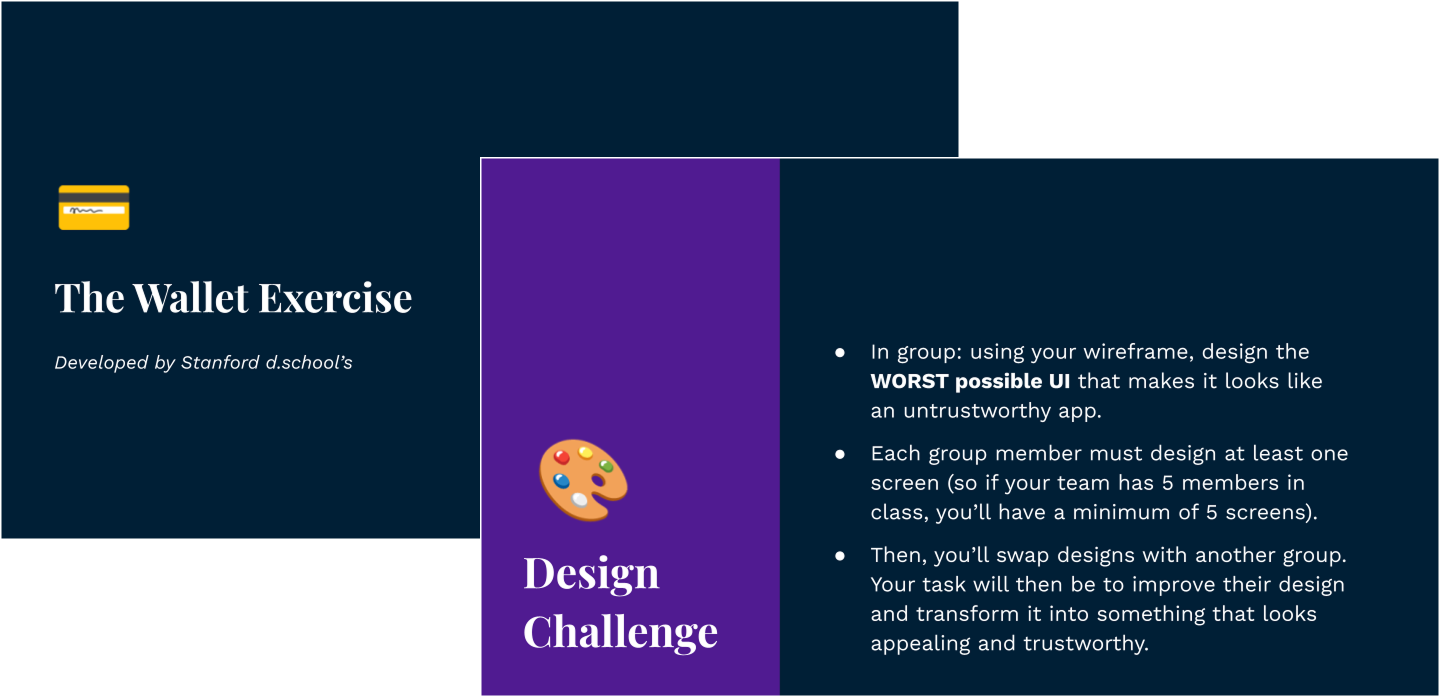
I focused on a studio-based classroom where hands-on activities drive class time. Each session centers on an interactive exercise, with students receiving feedback from peers and the instructional team. Examples include the Wallet Exercise (from Stanford d.school) to practice prototyping and projects like designing a trustworthy visual interface.
Live Classroom Quiz
INST367 – Prototyping and Development
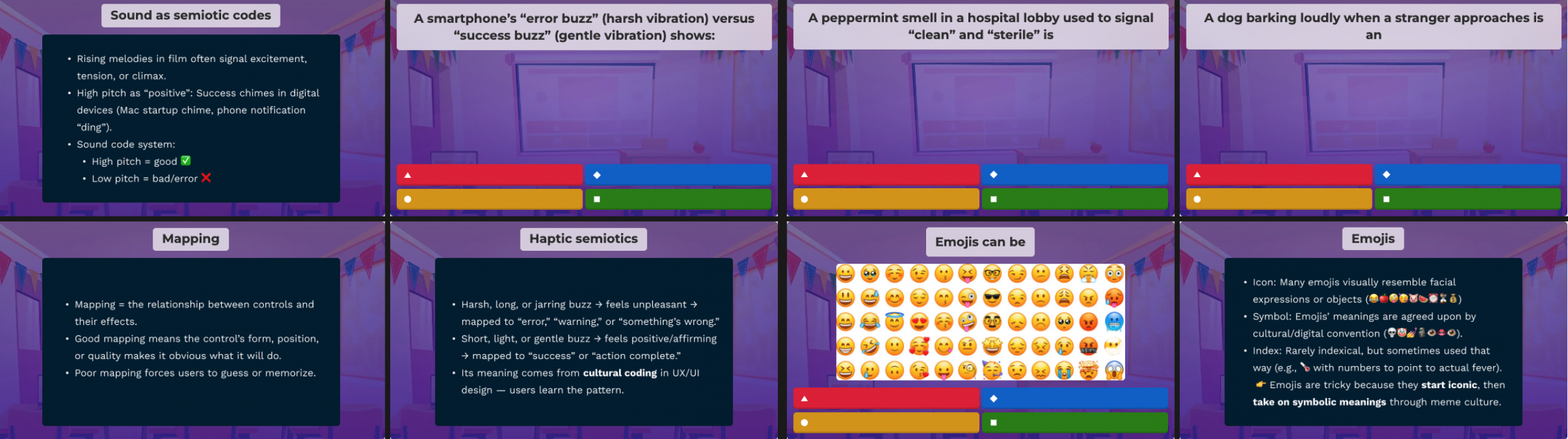
I aim to create an engaging classroom environment by incorporating interactive quizzes follow by lectures and explainations. This example shows a Kahoot session I used to introduce semiotics in one of my classes.
Live Coding - Basic shader
IMDM327 – Computational Virtual Reality
Introduced shader coding in Unity by guiding students through a live coding session to develop a simple starter shader.


Live Coding - Fractals
IMDM327 – Computational Virtual Reality
Building on the basic shader, this advanced coding exercise provides students with a fractal code snippet and guidance on how to extend it to generate different types of fractals.

Playtest
Learning thrives on inspiration from great examples. I set up playtesting sessions in several classes where students try out selected apps, which pushes them to explore on their own. I also guide them in analyzing these experiences which often lead to an open-ended discussion.


“Jamie is the G. She was always available and made sure she helped us with any resources that we needed to complete our projects. She was also great at facilitating the class and gave detailed feedback on our work.” – Anonymous (INST639P AR Design – View full report HERE)
“As someone pursuing a career in Product/UX Design, I think this course did a great job of covering important design topics. I especially enjoyed and found interesting the learning materials and resources provided and think they’re extremely relevant to UX today. I noticed a lot of the videos/books were timeless to design (e.g., the material being relevant after 8+ years), which I find important since technology and the UX field is evolving rapidly.
It can be hard to keep a class engaged for 2+ hours, but I think Professor Jamie did a great job. The environment was relaxed/flexible and not overly rigid, but also not chaotic. I enjoyed the mix of lecture and hands-on work.” – Anonymous (INST367 Prototyping and Development Studio)
Some examples of the work that I have mentored individually. Permission from students acquired.
New Works Incubator

from-the-beginning-even-still
Yoo-eun Lee & Donovan Lee

Tranquil Garden
Zayneb Omer
from-the-beginning-even-still
Yoo-eun Lee & Donovan Lee
Tranquil Garden
Zayneb Omer
Augmented Reality Design

Indoor Wayfinding
Zayneb Omer & Meghana Alla

RunnAR
Anmol Mishra, Pavlo Soldatov Mulyk, Timothy Chun